Lesson 4: a model that proposes useful work#
The fixture bridge from lesson 1 asked a model to echo the host's own next action: a connection test, deliberately empty of judgment. This lesson gives the model something real to say: a hypothesis, bound to observed surfaces and evidence, requesting an action the host then judges. The division of labor is the whole design: the provider wrapper parses and repairs, the schema names what a proposal is, and the policy alone decides what runs. Everything the model touches is advice.
Build this#
core/run/proposals.py: strict parsing with the fixture bridge's discipline, the hypothesis proposal schema, bounded repair, terminal policy refusals, provider error, timeout and cancellation statuses, and usage accounting. Plus the committed demo artifact with an admitted hypothesis, a repaired one, an exhausted session and a hostile-text refusal.
Start from here#
Lesson 3 complete: observations exist as records, and the write boundary is in place.
Inputs and outputs#
A proposal is one JSON object with exactly these keys and no others:
{"kind": "form-input-handling",
 "surface": "login_has_form",
 "evidence": ["login_status", "login_has_form"],
 "action": {"tool": "form_probe",
            "destination": "https://lab.example/login",
            "arguments": {"field": "username"}}}
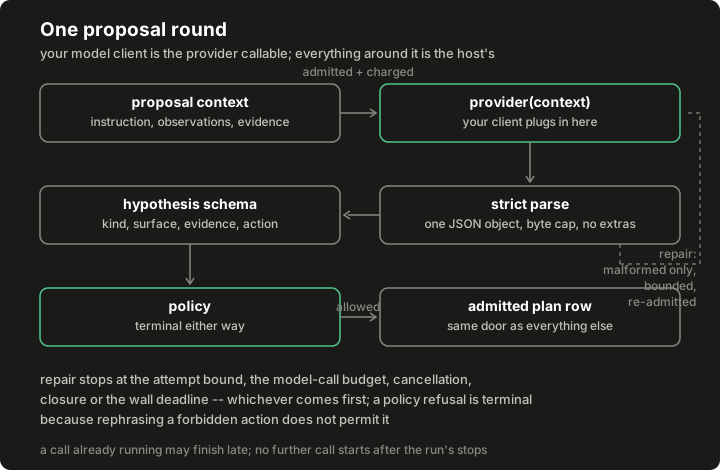
kind names the hypothesis family. surface and evidence bind it to recorded observations by name: a hypothesis about nothing the run observed is malformed, not merely weak. action is the request, and the session's answer is a report either way: admitted with the normalized action identity, or not admitted with a status naming exactly why: malformed, refused_by_policy, repair_exhausted, provider_error, timeout, cancelled, model_call_budget_exhausted or admission_refused, the last carrying the host's own stop reason.
Implement it#
-
Parse strictly.
run/proposals.py:parse_strictrestates the fixture bridge's discipline (a byte cap before parsing, duplicate JSON keys refused, nonstandard constants refused, an object or nothing) because the cheapest place to stop nonsense is before it becomes structure. A reply above the byte limit is malformed before it is parsed. -
Validate the shape.
run/proposals.py:validate_shapeholds the proposal to its exact key set and binds it to the run's records. Unknown fields are turned away by the schema before policy is even consulted. Evidence references have to name recorded observations. -
Bound the repair.
run/proposals.py:ProviderSessiongives the provider another attempt when a reply is malformed, carrying the validation error back as context, up to a small fixed budget. A malformed reply is repairable within the attempt budget; a policy refusal is terminal. The distinction is the lesson: a reply the parser could not use might improve with feedback, but a well-formed request for something forbidden is a policy answer, and rephrasing a forbidden action does not make it permitted. Repair exhaustion ends the session with a report, not an admitted action. -
Wrap the provider honestly. A provider is a callable and an outside process: exceptions come back as
provider_error, elapsed time past the deadline astimeout, and a cancellation callable stops the session between attempts. A provider exception, a timeout and a cancellation each end with their own status. The timeout is cooperative (read after the call returns) which surfaces a slow provider without interrupting it; real interruption needs process machinery outside this teaching module. The session accounts for calls and bytes either way. The model-call budget bounds a session across attempts. A host with wider stops (a wall clock, a closed run) hands the session anadmissioncallable, and the rule it buys is exact. The host's admission check is consulted before every call, repairs included: a call already running may finish past the run's stops, and no further call starts after them. -
Swap providers, not permissions.
run/proposals.py:FakeProviderreplays authored replies for tests and demos; your real client is any callable with the same one-argument shape. Two contracts exist and must not be confused: the model connection guide's bridge speaks the fixture lab's older action format and stays a connection smoke test, while this lesson's hypothesis contract is what the assembled application expects, andexamples/app_agent.pyis the executable wrapper that builds this exact schema and tool vocabulary around one transport, fake by default, your local model by flag. The guide carries the field-by-field migration table between the two. Changing the model wrapper does not change scope or execution permissions.
Run it#
python3 -m pytest tests/test_run_proposals.py -q
python3 -m core.run.demo_proposals --out /tmp/proposals-demo.json
diff -u data/course/proposals-demo.json /tmp/proposals-demo.json
Inspect it#
Open /tmp/proposals-demo.json. Four sessions against the same policy and observations. admitted_first_try carries the admitted proposal and the normalized action_id the rest of the pipeline will use. repaired_on_second_attempt shows the attempts list (malformed, then admitted) with the validation error that made the second attempt better. repair_exhausted is the bounded failure: a report, an attempts list, usage totals, and no action. hostile_retrieved_text is the one to read twice: the context contains retrieved text instructing the model to use an unapproved tool against an out-of-scope host, the fake provider obeys it, and the report says refused_by_policy with the tool refusal as its reason. Injected instructions in retrieved text can change what the model asks for, and cannot change what is permitted.
Break it#
Steer a well-formed proposal at a forbidden destination and watch which rule answers:
python3 - <<'PY'
import json
from core.run.demo_proposals import CONTEXT, OBSERVATIONS, VALID
from core.run.demo_records import build_policy
from core.run.proposals import FakeProvider, ProviderSession

forbidden = json.loads(VALID)
forbidden["action"]["destination"] = "https://other.example/"
session = ProviderSession(FakeProvider([json.dumps(forbidden), VALID]))
report = session.propose(CONTEXT, observations=OBSERVATIONS,
                         policy=build_policy())
print(report["status"])
print(report["reason"])
print([a["status"] for a in report["attempts"]])
print(report["usage"])
PY
Expected output:
refused_by_policy
destination https://other.example:443 is outside the explicit authorized origins
['refused_by_policy']
{'calls': 1, 'request_bytes': 255, 'reply_bytes': 219}
The provider held a perfectly valid second reply, and the session did not go back for it: one policy answer ended the session, with the usage ledger showing exactly one call. Compare that with the committed demo's repair case, where a malformed reply earned a second attempt: the two failure kinds get opposite treatment on purpose.
Build it yourself#
Your lesson 2 policy declares inspect_metadata; now write the provider that proposes it. Open starter/lesson04.py and build my_provider(context) to its docstring's contract: JSON text for one hypothesis: kind, an observed surface, evidence naming only recorded observations, and the action your policy authorizes. Then:
python3 -m pytest starter/lesson04_test.py -q
The starter's completion test fails on a fresh clone and passes only after your edit. Predict before running: if your evidence list names a field the run never observed, which layer refuses (the parser, the schema, or the policy) and with what status? (Check your prediction against the session report's attempts.) The worked answer is starter/solutions/lesson04.py.
Check completion#
-
A reply whose text cannot even be encoded is a malformed attempt with a repair round, not a provider failure.
-
A malformed reply is repairable within the attempt budget; a policy refusal is terminal. Repair exhaustion ends the session with a report, not an admitted action.
- Unknown fields are turned away by the schema before policy is even consulted. Evidence references have to name recorded observations. A reply above the byte limit is malformed before it is parsed.
- Injected instructions in retrieved text can change what the model asks for, and cannot change what is permitted. Changing the model wrapper does not change scope or execution permissions.
- A provider exception, a timeout and a cancellation each end with their own status. The session accounts for calls and bytes either way. The model-call budget bounds a session across attempts.
- The host's admission check is consulted before every call, repairs included: a call already running may finish past the run's stops, and no further call starts after them.
- A well-formed reply carrying the wrong types inside is one more malformed attempt, never a crash.
Each sentence is a named test in tests/test_run_proposals.py or tests/test_run_control_enforcement.py; completion is those suites green plus the byte-identical diff above. Scope the injection claim to what the tests actually exercise: an instruction in retrieved context steering the proposal toward an undeclared tool or an unauthorized destination. That is the attack class covered here: proposals that need permissions the policy withholds. It is not general prompt-injection immunity: hostile text can still waste attempts, skew which authorized action gets proposed, or poison the hypothesis text itself, and the context and verification lessons take those up.
Continue#
Lesson 5 turns admitted work into an eligible candidate set, ranks it, and executes it through the same recorder. Expect one marked detour on the way in: lesson 5 opens by sending you to lesson 10 for the small selection contract dispatch speaks (its top through step seven: the records, the feedback definition, the two baselines and the factory), and a bold return line there sends you straight back. It is a short read, and none of the adaptive machinery behind it is required.